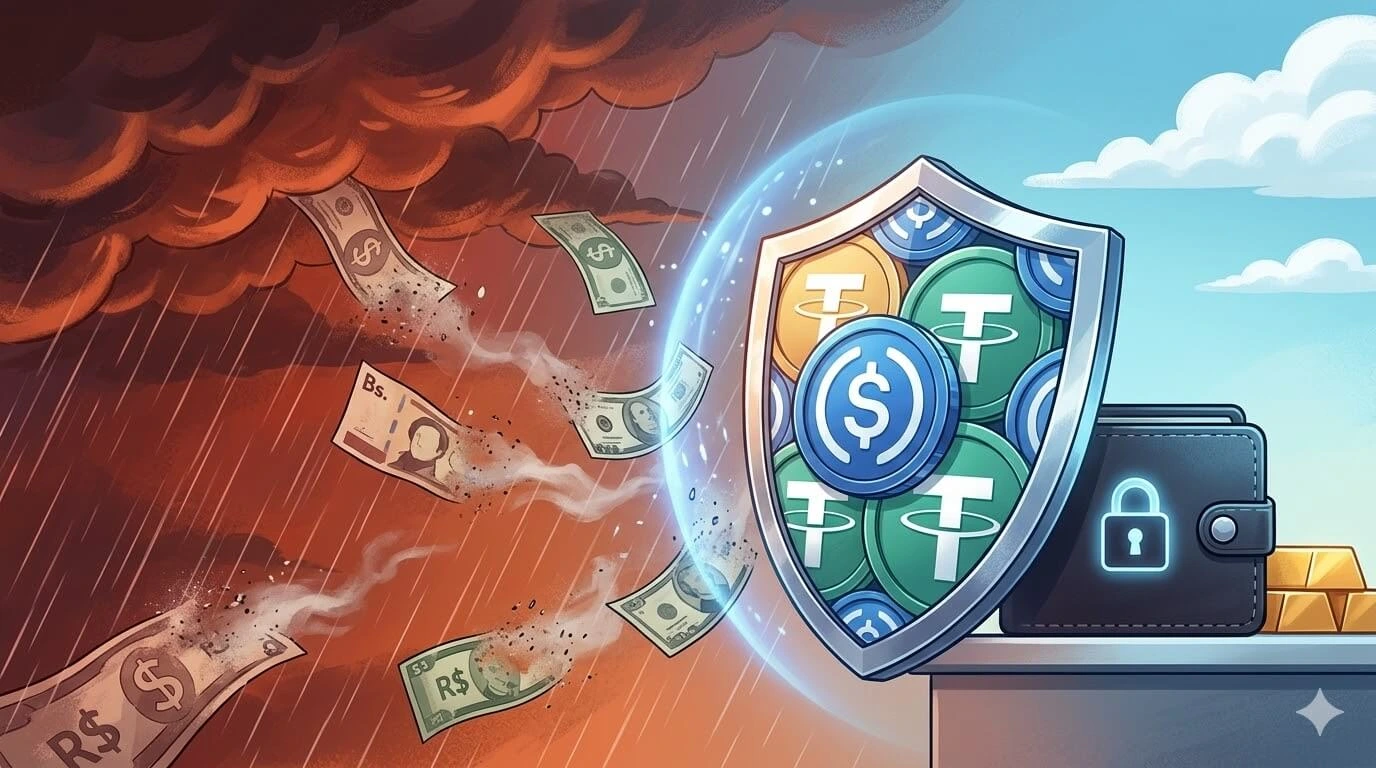
How to Protect Your Savings from Inflation with Stablecoins
This article contains affiliate links. If you open an account through them, we may receive a commission at no extra cost to you.
Inflation is a global problem — and not just in the most extreme cases. Turkey saw inflation above 70% in 2022. Nigeria, Egypt, and Pakistan have all experienced severe currency devaluations in recent years. Even in wealthier economies, the 2022–2023 inflation surge eroded purchasing power in ways that many people had not experienced in decades.
If your savings sit in a local currency that is losing value, you need tools to protect them. Dollar-pegged stablecoins — specifically USDC and USDT — offer one practical solution: synthetic dollars that anyone with internet access can hold, regardless of whether they have a US bank account.
Why dollar stablecoins work as an inflation hedge
USDC and USDT are stablecoins: digital assets designed to always be worth exactly $1 USD. Unlike Bitcoin or Ethereum, they do not fluctuate in price — they simply hold their dollar peg.
For someone earning in a depreciating local currency, converting a portion of savings to USDC or USDT is effectively a way to dollarize savings without the traditional barriers:
- No US bank account required: anyone with internet access can buy and hold dollar stablecoins.
- Available 24/7: unlike currency exchange offices, you can buy and sell at any time.
- Global transferability: send value anywhere in the world in minutes at low cost.
- Legal savings diversification: holding stablecoins is legal in most countries.
For background on how stablecoins work, read what are stablecoins.
How to get started: step by step
1. Open an account on Kraken
Kraken is one of the oldest and most regulated exchanges in the world, licensed in Europe and the US, and accessible from most countries globally. It supports SEPA bank transfers and credit/debit card deposits.
You can use the referral code 3ryh835p when signing up.
The identity verification (KYC) process takes 10–30 minutes and requires a valid government-issued ID.
2. Buy USDC
Once your account is verified, search for the USDC/USD or USDC/EUR pair in the trading panel. For long-term savings, USDC is preferable to USDT due to its stronger reserve transparency: Circle publishes monthly attestations audited by Deloitte and is well-positioned under EU MiCA regulation.
For a full comparison, read what is USDC and what is USDT.
3. Decide where to hold your USDC
You have two main options:
- Leave it on Kraken: the simplest option for beginners. Kraken holds your funds in custody. The tradeoff is that you depend on the platform.
- Move to a self-custody wallet (MetaMask, Trust Wallet, Ledger): you hold your own private keys, giving you full control. Safer long-term, but requires more technical knowledge and personal responsibility.
For most people starting out, holding funds on Kraken for the first few months is a reasonable approach while you learn.
To get started, open your account at Kraken.
Risks you need to understand
Stablecoins are not bank deposits. Before using them as an inflation hedge, understand the key risks:
- De-peg risk: in extreme market stress, a stablecoin can temporarily lose its dollar peg. This happened with algorithmic stablecoins (Terra/LUNA in 2022) and to a lesser extent with USDT during the March 2023 banking crisis. USDC has historically been more stable.
- Issuer risk: if Circle or Tether became insolvent and could not back their reserves, the stablecoin would lose value. The probability is low but not zero.
- Exchange risk: if you leave funds on Kraken and the exchange experiences problems (hack, insolvency), you could lose access. Self-custody eliminates this risk.
- Not insured: unlike bank deposits (covered up to €100,000 in the EU by deposit guarantee schemes), stablecoins have no deposit insurance.
The key rule: do not store more in stablecoins than you could afford to lose.
Can I earn yield on my stablecoins?
Beyond hedging against local currency inflation, some users look to generate returns on their USDC. Some platforms offer 4–6% APY on USDC deposits — which in itself can exceed the inflation rate in many developed economies.
However, these yields come with additional platform risk (counterparty risk, DeFi protocol risk). We do not recommend specific protocols here, but it is worth researching if you already have experience with the crypto ecosystem.
USDC or USDT for savings?
The short answer: USDC for savings, USDT for trading.
| Criterion | USDC | USDT |
|---|---|---|
| Reserve transparency | High (monthly Deloitte audits) | Medium (quarterly reports) |
| MiCA regulation | Better positioned | Greater uncertainty |
| Liquidity | High | Very high |
| Available networks | Ethereum, Solana, Base, others | Ethereum, Tron, Solana, others |
For a detailed comparison, see what is USDC and what is USDT.
Conclusion
Whether you live in a country with runaway inflation or simply in one where the purchasing power of savings is slowly eroding, dollar stablecoins provide a practical and legal tool for protecting your money. They are not without risk — but for many people they are clearly preferable to holding everything in a depreciating local currency.
The simplest starting point is to open an account on a regulated exchange, buy a small amount of USDC to learn how it works, and gradually build from there.
If you want to start protecting your savings from inflation, Kraken is the most accessible regulated exchange for international users.

Comments