What Is Cardano (ADA)
Cardano is an open-source platform launched by IOHK in September 2017 that represents a very ambitious project. It claims to be building the third generation of cryptocurrencies, where the first generation is Bitcoin and the second is Ethereum.
Its cryptocurrency, called ADA, was already in the top 10 by market capitalisation despite its few months of existence, with 26 billion coins in circulation out of a total of 45 billion.
Philosophy
All Cardano members and developers, including Charles Hoskinson — one of the original co-founders of Ethereum — are publicly listed on the website, and they produce a great number of videos in which they try to explain each technical feature in a more accessible language.
One of the things I like most about Cardano is that it has not needed to over-promote itself. It aims to be a solid project focused on its technological solution before trying to sell itself through ICOs, as so many other coins do.
Its creators are engineers and scientists who first conducted extensive research and produced documentation, and only afterwards began building. This may sound like a very simple approach, but what most cryptocurrencies do is copy Bitcoin’s code and then make modifications on top of it. Cardano, by contrast, decided to start the project entirely from scratch, approaching it first from an academic perspective.
I encourage anyone with a good command of English to take a look at the quantity of academic papers that Cardano has produced to explain its entire technological solution before writing a single line of code.
Ouroboros
Cardano uses a Proof of Stake algorithm developed by its own team, called Ouroboros. Proof of Stake mechanisms are far more energy-efficient than Proof of Work (used by Bitcoin and Ethereum, although the latter has since moved to Proof of Stake). Proof of Stake is a very complex mechanism to implement securely, but the members of IOHK claim to have achieved it and have publicly released extensive documentation on the subject.
Daedalus

Daedalus is the wallet offered by IOHK. It can be downloaded from its website and over time aims to support other currencies, becoming a universal wallet.
Why Are They Building It?
The first generation — Bitcoin — can only perform simple peer-to-peer transactions and is still not very practical for more complex operations. Ethereum introduced the concept of smart contracts, which has been a revolution that placed it in the second position among cryptocurrencies. Even so, smart contracts are somewhat limited and carry certain unresolved problems that Cardano took into account from the very beginning.
These problems are:
Scalability.
Being able to process many more transactions per second (TPS) without needing to weaken the protocol by stripping out features or security patterns to achieve it (which is precisely how EOS managed to achieve such a high TPS volume). BTC and Ethereum still support very few transactions per second (10 and 30 TPS respectively), while VISA or Mastercard can handle tens of thousands of transactions. If cryptocurrencies are ever to replace these conventional payment methods, scalability must be resolved. Cardano currently supports up to 15 TPS, but it is being built in such a way that the more users there are, the more TPS it will be able to process — scaling in a manner similar to a torrent network.
Interoperability.
Interacting with other blockchains. Cardano does not aim to replace Bitcoin, as it foresees a world with many other currencies in circulation, and proposes a scenario where currencies can operate with each other and additionally with the traditional banking system.
Sustainability.
Keeping the community united and ensuring flexible, funded development. Today there are many questions about what the true Bitcoin is — Bitcoin? Bitcoin Cash? Bitcoin Gold? Every fork of a currency divides the community. There is also the question of how the development team is funded so that progress always continues.
Cardano wants to bring decision-making power to people in a decentralised way and thereby try to mitigate this problem. To do so, it has borrowed from Dash its concept of a Treasury, where developers receive a fee from each mined block, along with a voting system that allows the community to choose the direction in which the currency’s development should move.
The Road Ahead
Cardano will grow gradually until it can offer features such as smart contracts, sidechains, metadata, and multi-party computation.
The Cardano development roadmap can be viewed on its website. Some of the upcoming improvements they promise include credit cards for everyday use, voting systems, and Quantum-resistant signatures (a security concern discussed in anticipation of the day when quantum computers might be able to compromise the network).
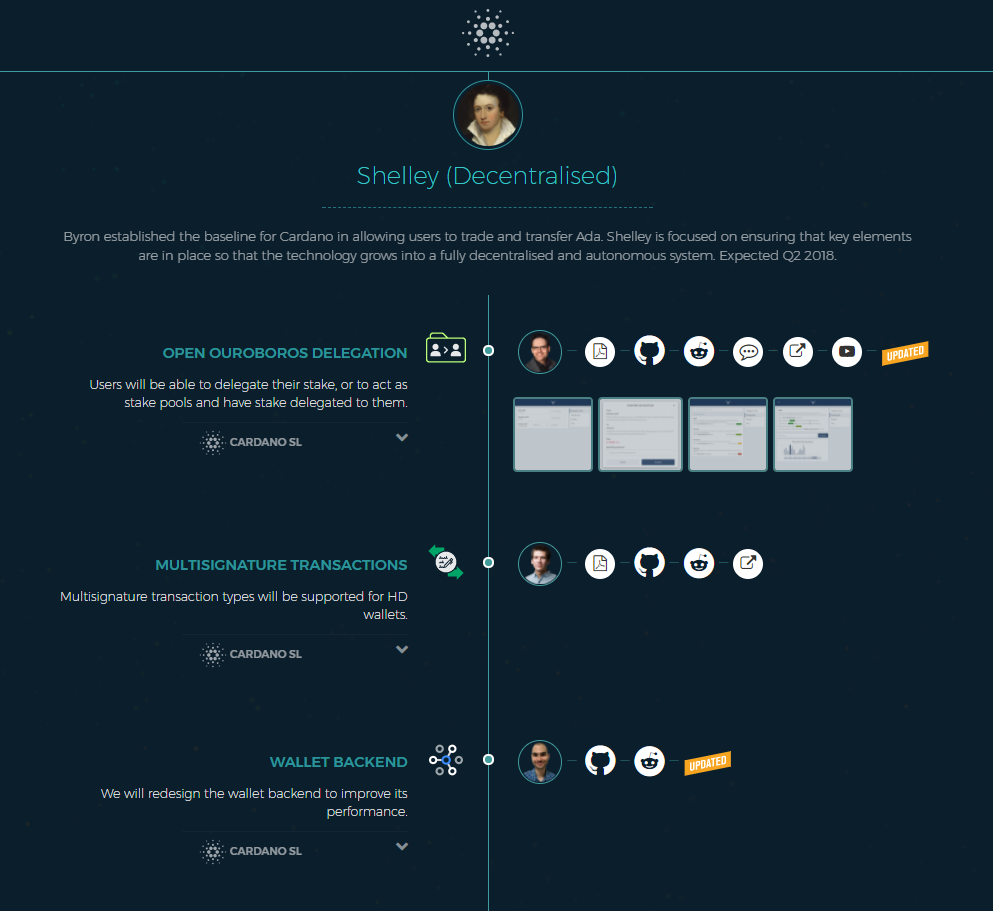
I love the fact that every item on the roadmap lists the specific individuals responsible for it, with links to both their personal GitHub profiles and the repositories for the developments themselves. This allows anyone with knowledge of the field to inspect how the problems are being solved and to audit the code.
Even for those who have no programming background, I recommend taking a look before investing, to get a sense of how active the developments are. It is a very bad sign when projects like these show no signs of activity.
Technical Solution
The programming language used is Haskell, which is widely used and considered one of the most secure in the community.
The code follows a Hack-Proof philosophy — the same method used by the military or NASA when carrying out their developments, on the assumption that a programming error is completely unacceptable. While a bug in Facebook might result in some misaligned text, a bug in a space rocket could cost human lives. This is why rigorous quality reviews are carried out. While they do not make it impossible to hack or fail, they make it considerably more difficult.
As incredible as it may seem, the vast majority of blockchain projects do not follow this philosophy. One only has to look at The DAO, where a simple programming error — placing one line of code before another — caused such a catastrophe in the Ethereum world that a new currency (Ethereum) had to be created to resolve the problem, while the original currency (which came to be known as Ethereum Classic) was swept under the rug and continues to trade at a significantly lower price.
Where to Buy Cardano (ADA)
ADA can currently be purchased in exchange for Bitcoin or Ethereum. I particularly like the Binance exchange.
Opinion
In the end, as always, it will be the market that decides how useful and valuable the currency will be — no matter how good or promising it is, if it is not ultimately used, it will die. The project has been active for a very short time and for now it must be made clear that its practical utility is absolutely zero and everything remains future promises.
On the other hand, the Cardano team is doing an incredible job trying to explain everything they are doing and the direction they are moving in. I encourage you to take a look at their YouTube channel (entirely in English) and see for yourselves.
Over the coming years we are going to see hundreds of new cryptocurrencies and blockchain technologies announced with great fanfare in order to raise millions of dollars in their ICOs, only to fail to deliver on what was promised. Very few of them will truly succeed, regardless of how promising they appear or how little competition they face. The vast majority of these failures will be due to rushed technological solutions produced without careful market and technology research.
Cardano, meanwhile, is quietly rolling out new features one by one and building a highly stable, audited platform. If its passion for scientific rigour and documentation continues, it will undoubtedly have a great deal more to say. Whether it will be the next Ethereum is something only time will tell — what is clear is that no other cryptocurrency is doing things quite this way.

Comments