How to Read Candlestick Charts in Crypto: A Visual Guide for Beginners
Japanese candlestick charts are the most widely used tool for analysing the price of Bitcoin and other cryptocurrencies. Although they may look intimidating at first, the logic is simple: each candle tells a story about what buyers and sellers did during a given time period.
What is a Japanese candlestick
A Japanese candlestick represents the price movement during a specific period — it could be 1 minute, 1 hour, 1 day, or 1 week. Each candle contains four essential data points:
- Open: the price at the start of the period
- Close: the price at the end of the period
- High: the highest price reached
- Low: the lowest price reached
Anatomy of a candle
A candle has two parts:
- Body: the thick rectangle showing the difference between open and close
- Wicks (or shadows): the thin lines above and below the body, indicating the high and low
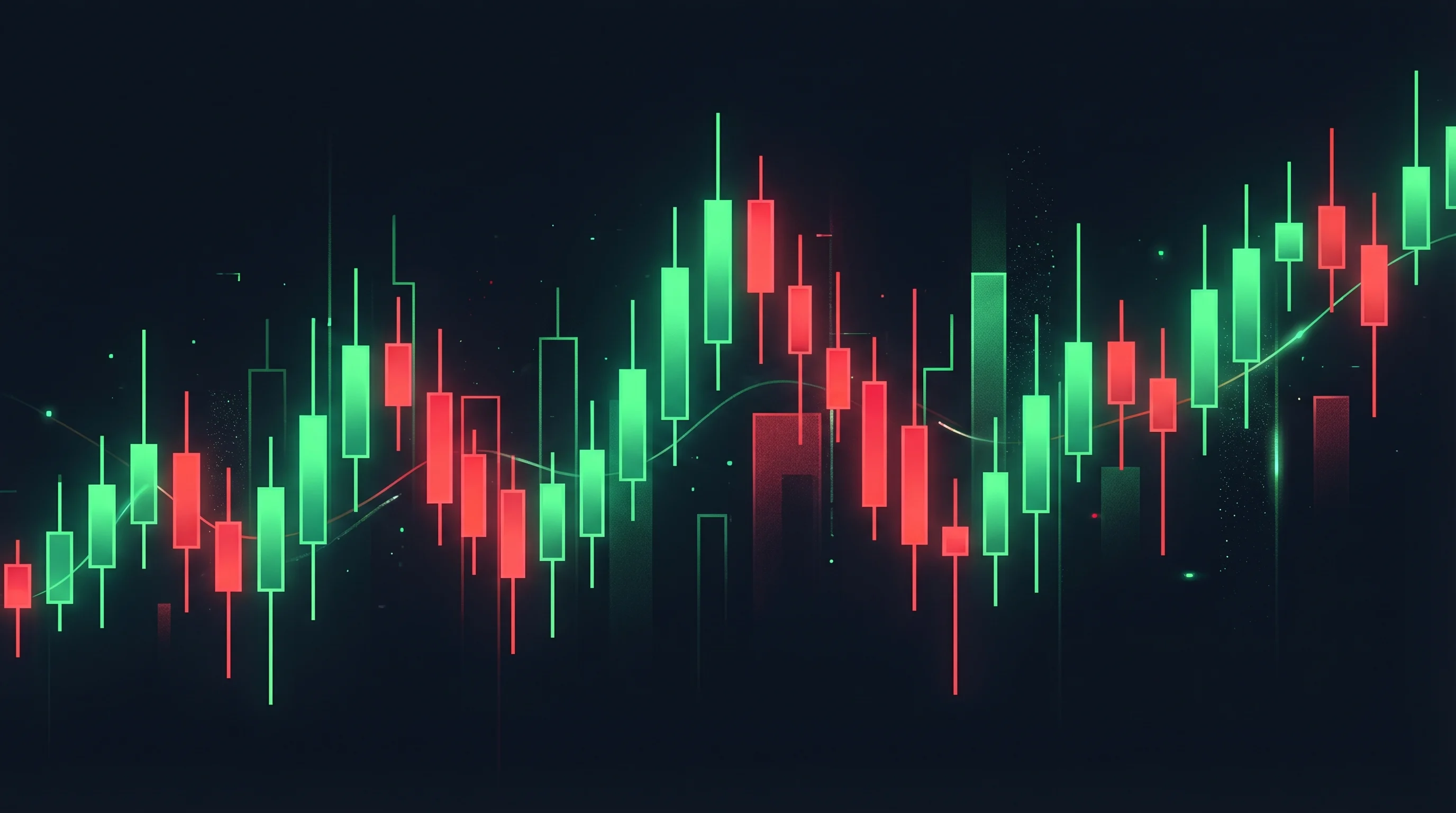
If the price closed above the open, the candle is green (bullish). If it closed below, the candle is red (bearish).
| Element | Green candle (bullish) | Red candle (bearish) |
|---|---|---|
| Top of body | Close | Open |
| Bottom of body | Open | Close |
| Upper wick | Period high | Period high |
| Lower wick | Period low | Period low |
What the body tells us
The size of the body conveys immediate information:
- Large green body: strong buying pressure — buyers dominated the period
- Large red body: strong selling pressure — sellers dominated
- Small body: indecision between buyers and sellers
What the wicks tell us
Wicks reveal the extremes the market tested but could not sustain:
- Long upper wick: the price rose significantly but sellers pushed it back — resistance signal
- Long lower wick: the price dropped significantly but buyers recovered it — support signal
- No wicks: buyers (green) or sellers (red) controlled the entire period without opposition
Time frames: which scale to choose
Each candle represents a configurable time period. The time frame you choose completely changes the perspective:
| Time frame | Typical use | Noise |
|---|---|---|
| 1 min – 15 min | Scalping, intraday trading | High |
| 1 hour – 4 hours | Short-term trading | Medium |
| Daily | Swing trading, medium-term investing | Low |
| Weekly – Monthly | Long-term investing, macro trends | Very low |
Tip: if you are just starting out, use daily candles. They offer a clear view without the excessive noise of shorter time frames.
Essential candlestick patterns
Candlestick patterns help anticipate possible trend changes. They are not infallible — always confirm with volume and context — but they are useful tools.
Single-candle patterns
Hammer
- Small body at the top, long lower wick (at least 2x the body)
- Appears after a decline: sellers pushed the price down, but buyers recovered it
- Signal: possible bullish reversal
Shooting Star
- Small body at the bottom, long upper wick
- Appears after a rise: buyers tried to push higher, but sellers rejected it
- Signal: possible bearish reversal
Doji
- Virtually no body (open ≈ close), with wicks in both directions
- Reflects total indecision between buyers and sellers
- Signal: possible trend change, especially after a prolonged trend
Two-candle patterns
Bullish Engulfing
- After a decline: a small red candle followed by a large green candle that completely “engulfs” the previous body
- Signal: buyers have taken control
Bearish Engulfing
- After a rise: a small green candle followed by a large red candle that engulfs the previous one
- Signal: sellers have taken control
Three-candle patterns
Morning Star
- Large red candle → small body candle (indecision) → large green candle
- Signal: strong bullish reversal, especially with high volume on the third candle
Evening Star
- Large green candle → small body candle → large red candle
- Signal: strong bearish reversal
How to read a complete chart
Reading individual candles is useful, but context is everything:
1. Identify the trend
Before looking for patterns, determine whether the market is in:
- Uptrend: higher highs and higher lows
- Downtrend: lower highs and lower lows
- Sideways range: price oscillating between support and resistance
2. Find support and resistance
- Support: a price level where buyers historically step in and halt the decline
- Resistance: a level where sellers appear and halt the rise
Candlestick patterns are more significant when they occur at these key levels.
3. Confirm with volume
A candlestick pattern without volume is less reliable. If a bullish hammer is accompanied by high volume, the signal is much stronger than if volume is low.
4. Do not trade on a single pattern
Candlestick patterns are one tool among many, not a crystal ball. Experienced traders combine them with:
- Moving averages (SMA, EMA) to confirm trend
- RSI (Relative Strength Index) to detect overbought/oversold conditions
- Volume to validate the strength of a move
Where to view crypto candlestick charts
| Platform | Free | Ideal for |
|---|---|---|
| TradingView | Yes (basic plan) | Full technical analysis with indicators |
| CoinGecko | Yes | Quick price and trend views |
| CoinMarketCap | Yes | Market data and basic charts |
| Kraken | Yes (with account) | Trading with integrated charts |
Common mistakes when reading candles
- Looking for patterns on very short time frames — 1-minute candles have too much noise; patterns are unreliable
- Ignoring context — a hammer in the middle of a sideways range does not carry the same weight as one after a prolonged decline
- Trading every pattern — not all patterns confirm; wait for volume and context to support it
- Forgetting risk management — no pattern guarantees the outcome; always use a stop-loss
If you want to put what you have learned into practice, Kraken offers professional candlestick charts with built-in technical indicators and an intuitive interface on both web and mobile.
Conclusion
Candlestick charts are the visual language of the market. Learning to read them will not make you a professional trader overnight, but it will give you a solid foundation for understanding what is happening with any cryptocurrency’s price. Start with daily candles, learn the basic patterns, and above all, never trade based solely on a pattern without considering the full market context.

Comments